⭐ FEATURED
🌌
Galactic Map
Interactive 3D map of the Milky Way and beyond — 100+ catalog stars with accurate Hipparcos distances, 90,000-particle spiral arms, and S-star orbits around Sgr A*.
- Logarithmic spiral arms (13° pitch, 4-arm model)
- Stars out to Andromeda (2.5 Mly) + Ton 618
- S2 star orbit around Sgr A* (16.05 yr)
- Click-any-star info panel with spectral data
Launch Simulator →
⭐ FEATURED
☀️
Solar System
Hardware-accelerated 3D solar system — accurate orbital periods for all 8 planets + moons, asteroid belt, CME bursts, and live NOAA space weather.
- Keplerian orbits · 19 moons · Ceres + asteroid belt
- G2V photosphere + granulation shader
- Live SWPC solar wind, Kp, X-ray on Earth shader
- Double-click Earth → zoom into Earth View
Launch Simulator →
🌐 LIVE DATA
🌍
Earth View
Real-time 3D Earth with live NOAA/SWPC space weather — magnetosphere geometry, radiation belts, aurora curtains, and ionospheric analysis from live solar wind data.
- Shue-1998 magnetopause · bow shock · Van Allen belts
- Kp-driven aurora oval (green → magenta at storm)
- D/E/F2 ionospheric layer analysis + HF blackout flag
- Live DSCOVR solar wind · GOES X-ray · OVATION aurora
Launch Simulator →
🌅 LIVE DATA
☀️
The Sun — Live
G2V 3D simulator with real-time NOAA/SWPC data — active region markers, GOES X-ray flux, and recent flare log updated live.
- NOAA active region 3D markers (torus rings)
- Live GOES X-ray class (A/B/C/M/X)
- 48h flare log + fly-to-region camera
- Granulation · corona · solar wind shader
Launch Simulator →
🎨
2D Star Modeler
Explore 12 different stellar classifications from blue giants to black holes with accurate scientific data.
- 12 star types (O-M class + remnants)
- Real temperature & mass data
- Adjustable parameters
- Solar wind visualization
Launch Simulator →
🌊
Advanced Solar Physics
Simulates Parker spirals, coronal mass ejections, solar flares, and fluid dynamics with multiple visualization modes.
- Parker spiral trajectories
- 6 emission modes (CME, flares, etc.)
- Density grid simulation
- Magnetic field visualization
Launch Simulator →
⚡ NEW
💧
Navier-Stokes Fluid Sim
Real computational fluid dynamics with full Navier-Stokes solver, Parker spirals, and ultra-compact terminal UI.
- Real CFD equations
- Divergence & curl calculations
- Pressure projection solver
- Terminal-style data-dense UI
Launch Simulator →
⚡ NEW
🕳️
Black Hole Fluid Sim
2D accretion disk fluid dynamics with Jos Stam stable fluids solver — BH gravity, jets, event horizon sink, and photon ring rendering.
- N=128 Eulerian grid (Jos Stam 1999)
- BH gravity + ISCO infall + jet injection
- 4 presets: Stellar → AGN → SMBH → Ton 618
- Thermal / velocity / pressure colormaps
Launch Simulator →
⚡ NEW
🌀
Stellar Wind Dynamics
Parker spiral magnetic field + stellar wind particle simulation with Alfvén surface, termination shock, heliopause, and bow shock boundaries.
- Parker (1958) spiral field lines
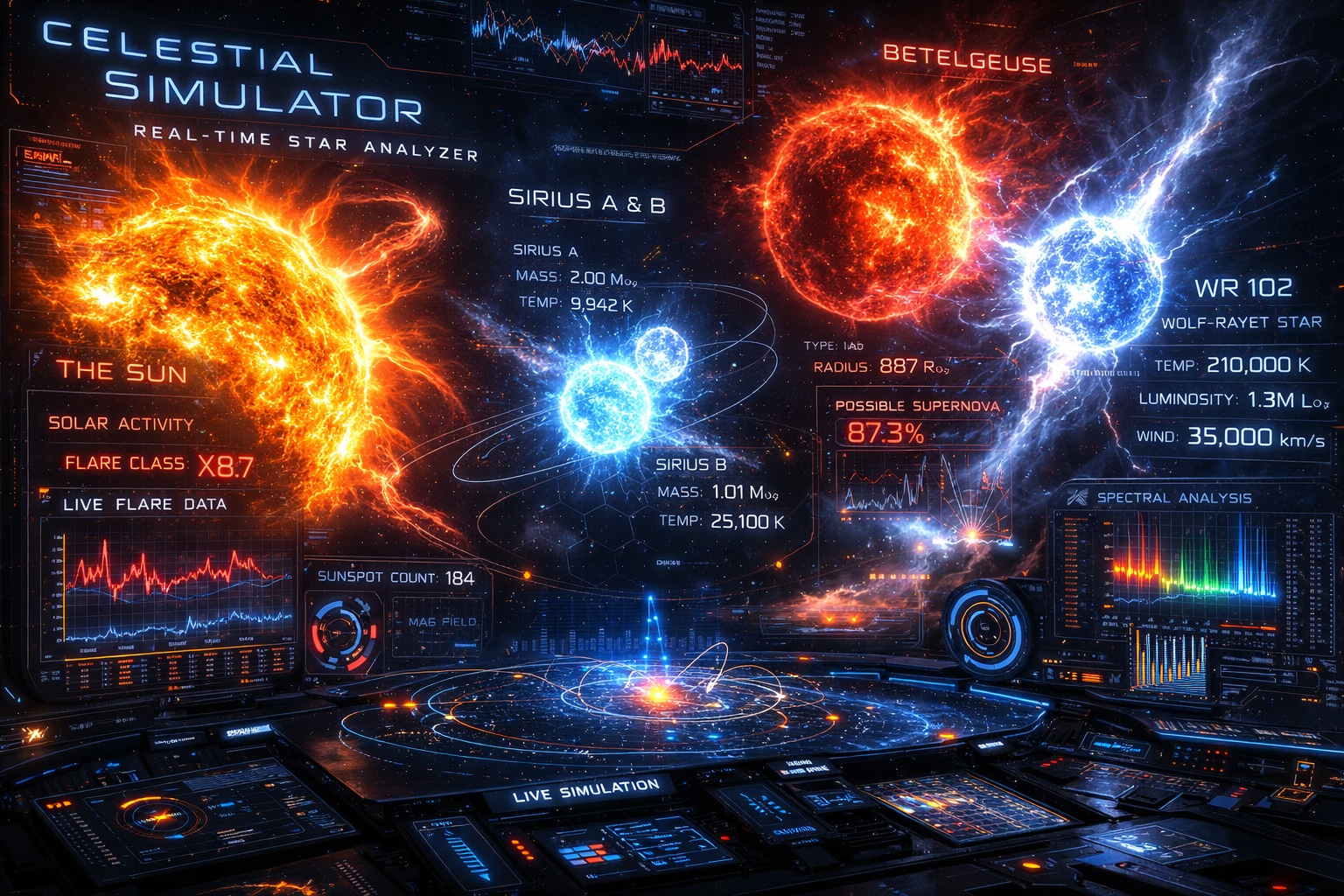
- 4 presets: Sun · WR 102 · Betelgeuse · Pulsar
- Alfvén radius & termination shock physics
- CME burst, flare & coronal hole events
Launch Simulator →
⭐ NEW
💥
WR-102
Wolf-Rayet stellar wind simulator — the hottest known star at ~210,000 K with extreme mass-loss and 5,000 km/s winds.
- WO2 spectral class, Teff ~210 000 K
- Interactive β-law wind controls
- Real-time parameter sliders
- ACESFilmic tone-mapped WebGL
Launch Simulator →
⭐ NEW
⸻
Vega (α Lyrae)
Rapid-rotator A0V star simulator — Vega spins so fast its equator bulges 23 % wider than its poles, with gravity darkening across the disk.
- Oblate spheroid geometry (von Zeipel)
- Pole-to-equator gravity darkening
- Live oblateness & Teff sliders
- A0V blackbody surface shader
Launch Simulator →
⭐ NEW
🔴
Betelgeuse
The famous red supergiant M2Iab — giant convective cells, pulsation, TiO molecular shell, asymmetric dust envelope, and slow stellar wind.
- Large-scale convective plumes
- Semi-regular pulsation animation
- Asymmetric dust shell (Great Dimming)
- TiO molecular absorption model
Launch Simulator →
⭐ NEW
⸻
Sirius System
The Sirius A1V + DA2 white dwarf binary — watch them orbit with elliptical Keplerian dynamics and compare the brilliant blue-white primary to its tiny, dense companion.
- Eccentric binary orbit (e=0.591)
- Sirius A: A1V blue-white main sequence
- Sirius B: DA2 white dwarf (0.0084 R☉)
- Interactive orbit speed & inclination
Launch Simulator →
🌟 CLASSIC
🌐
Sirius Planetary Fantasy
A speculative planetary system around Sirius A & B — full orbital mechanics, imagined worlds in the habitable zone, and the stellar wind from this brilliant binary pair.
- Sirius A & B full binary orbit (e=0.591)
- Fantasy planet roster with Keplerian orbits
- Stellar wind particle system (Sirius A)
- Speed presets: realistic & visual modes
Launch Simulator →
⚠️ Experimental
🦀
Rust/WASM 3D
High-performance native code compiled to WebAssembly using the Bevy game engine — fluid simulation, magnetic field tracing, and particle advection.
- Native Rust performance in-browser
- Bevy ECS architecture (0.17)
- 3D magnetic field line tracing (RK4)
- GPU compute fluid advection
Launch Simulator →
🖥️
Python Desktop Version
Full-featured desktop application with OpenGL rendering and the Celestial Studio creator tool.
- Native OpenGL performance
- Celestial Studio creator (12 object types)
- Scene save/load JSON export
- Windows / Linux / macOS
View on GitHub →